LumberJocks Woodworking Forum banner

Cutting circles on router table

7.7K views 39 replies 10 participants last post by  MsDebbieP  
#1 · (Edited by Moderator)
Good day everybody…long time no see…(or long time no jig…)

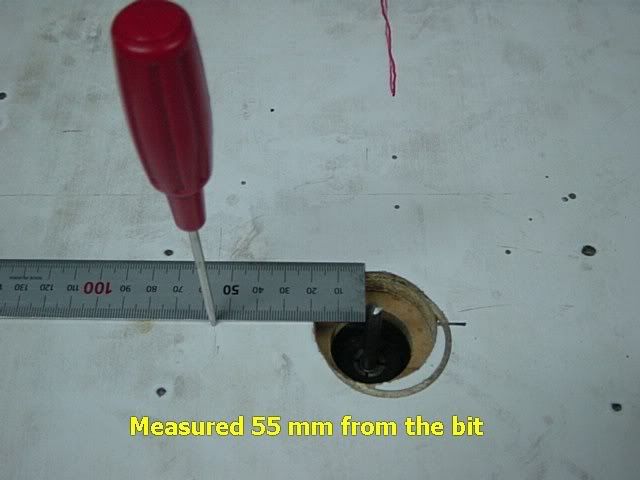
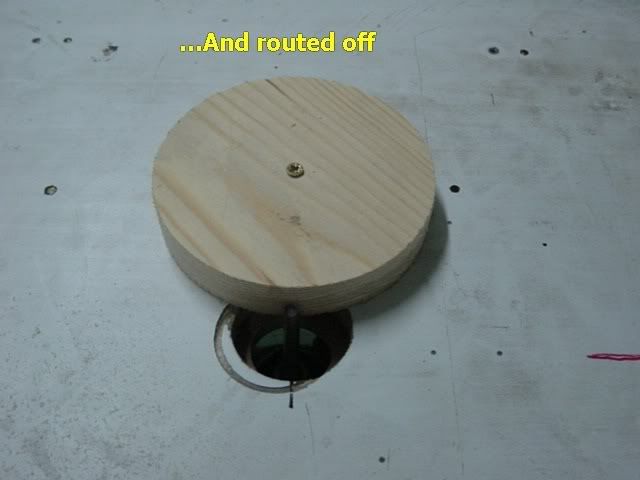
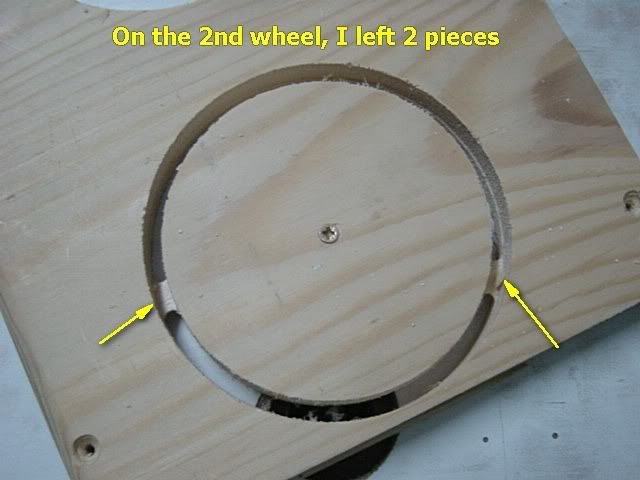
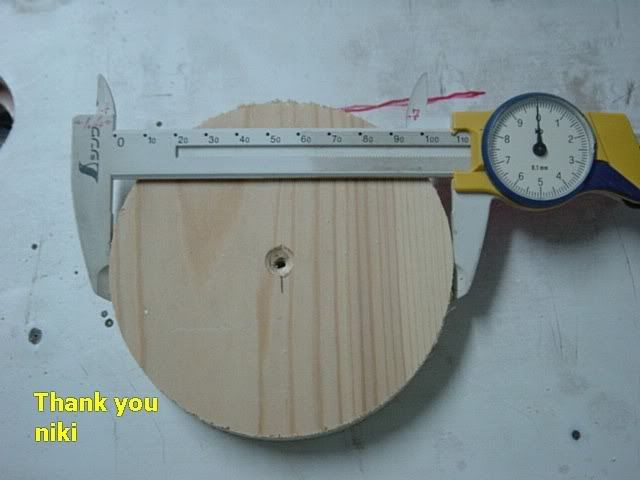
I had to cut 110 mm (4-5/16") diameter circles to plug some holes.
I don't have trammel because I almost did not have the need to cut circles.

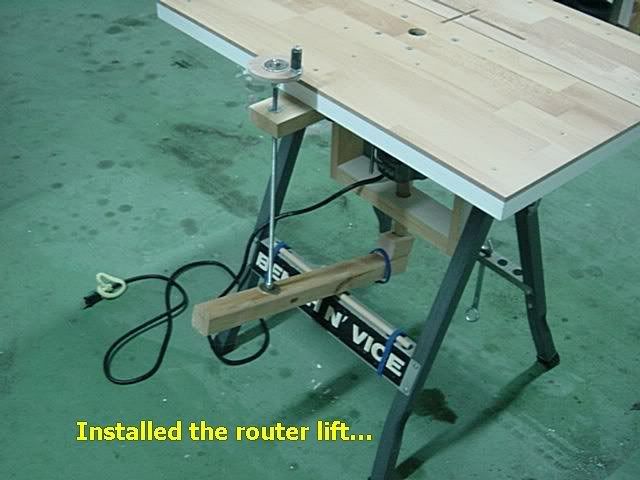
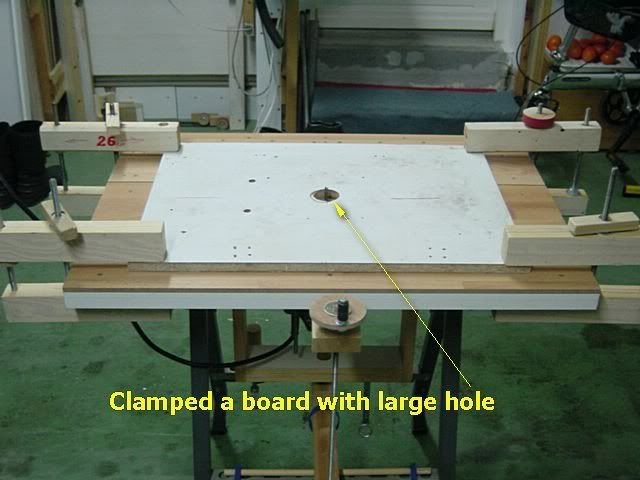
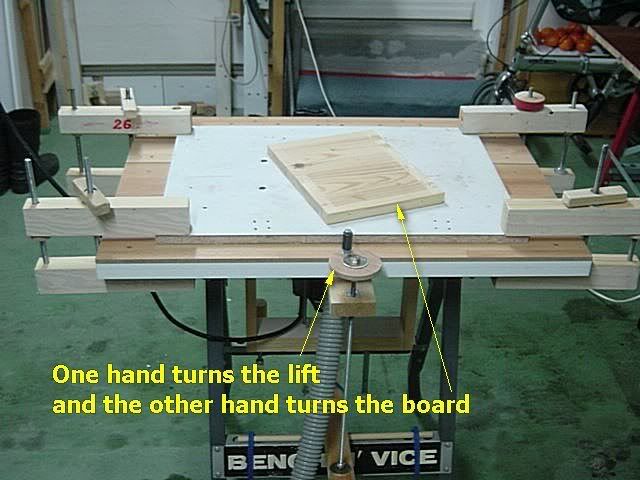
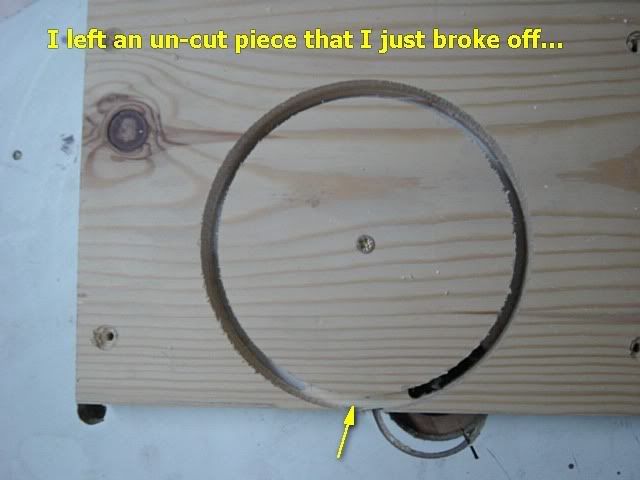
I used 6 mm (1/4") bit and using the router lift, I lifted the bit till I heard the first "ZZZZeeeeeee" (you know what I mean) and turned the board one round…turned the lift 2 rounds and the board one round and so on…

Regards
niki

Photo Sharing and Video Hosting at Photobucket

Photo Sharing and Video Hosting at Photobucket

Photo Sharing and Video Hosting at Photobucket

Photo Sharing and Video Hosting at Photobucket

Photo Sharing and Video Hosting at Photobucket

Photo Sharing and Video Hosting at Photobucket

Photo Sharing and Video Hosting at Photobucket

Photo Sharing and Video Hosting at Photobucket

Photo Sharing and Video Hosting at Photobucket

Photo Sharing and Video Hosting at Photobucket
 
#2 ·
Niki, I am continually impressed by your ingenuity. You regularly devise ways of doing things and after I've seen them they seem so straightforward, and still something I wouldn't think of. Count me as one of your fans.
 
#4 ·
Thank you so much

Russel
That's what happens when I don't have a trammel but, even if I had, I feel better and safer to turn the board instead of turning around and around the board…

I'm planning now something with fixed pivot that I can move to any distance on the router table to get any circle diameter….up to some limit of course…

Tom
Those clamps are not "improvisation" :) I use them any time I need good grip….I posted them somewhere…

Regards
niki
 
#7 ·
Thank you so much

Bruce
If I'll sit down to write a book, I'll not have time to make jigs and work in the garage….that is much more interesting than writing a book…

Bob
Till a few days ago, I did not need a trammel for my works.
I'm not drilling any holes on the router table and even the new design that I'm planning will be held with clamps to the table.

Usually, I'm using materials that cannot be used for any furniture and normally, they are left overs of Melamine and I have many of them…the one that you see on the pics was used before as a small working table…

Regards
niki
 
#8 · (Edited by Moderator)
Nicki I am confused.
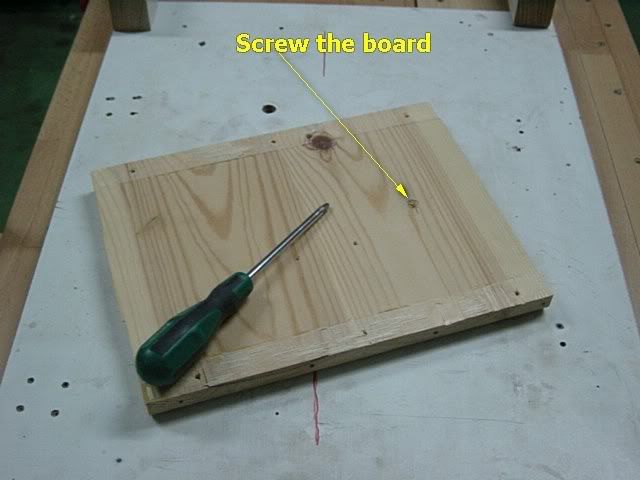
I see a screw in the part and it looks like it is screwed to the table top?
Help me out here.
Is that big chunk of melamine and those four big clamps fitted on top of your router table?
No wonder the bit can't reach the parts.
You should make a trammel.
Image

Bob
 
#9 ·
Hi Bob

The workpiece is held to the Melamine board with a screw and boes not penetrate into the router table itself.

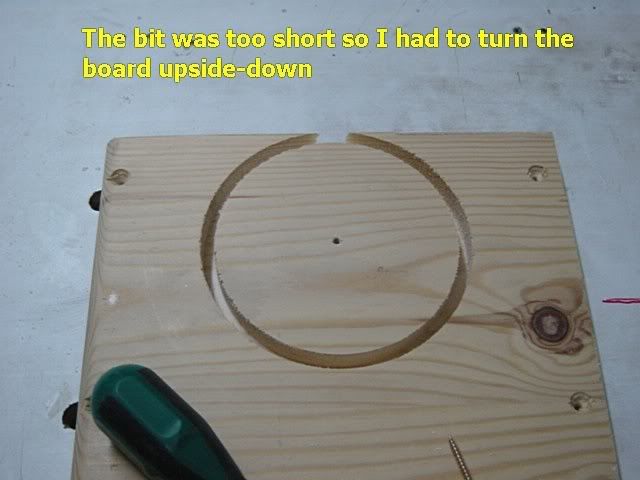
You are correct that the Melamine board is thick (3/4") but the reason that the bit did not reach all the way through the workpiece was my fault…I left the depth stop locked (from previous job)....I used long bit (2") that could easily go all the way up but…well, we all have our mistakes….

I'm planning to use 8mm (5/16") so I shall get extra 3/8" depth.

I don't have much of a need to cut circles but I think that with trammel I shall need also a backing board under the workpiece (held firmly to the workbench) and a carpet tape to hold the workpiece to the backer board…in my opinion, my set-up it much simpler but, it's just me…

Regards
niki
 
#10 ·
Hi Nicki
I would also like to point out that using a 6 mm (1/4') router bit that is 2" long is not only really tough on the router and collet but will likely prematurely ruin the bearings.

Secondly,from safety point of view the smaller diameter cutters have a tendency to work loose in most collets and even more so if they are extended bits as you have used.

It appears the your router table is about 1/2" thick, the melamine sheet is 3/4' thick and the circle material is 3/4" thick. That makes it about 2 full inches of extension of the bit outside the router collet.

For my tastes and working technique that is not a safe set up.

I mention this because we have a number of people here just learning about woodworking machines and I would hate to see them counciled into a disaster or worse a personal injury.

I firmly believe that the trammel setup is a far safer approach than what you have shown us here.
I grant that you will have to use a nonslip surface to router against but they are only a few dollars a meter at most tool stores.
Also flipping the board overhalf way through to prevent scoring the under pad.
I note you had to do this with your set up because the bit would not reach though all the material.

Regards
Bob
 
#11 · (Edited by Moderator)
Hi Bob

You are correct that 1/4" shank - 2" long is tough on the router and even dangerous because it can break at high loads and I would not suggest a beginner to use them but…

All the "kuntz" (German - trick) is in the way that I use it…because the router lift is outside of the table area, as you can see, I'm lifting the bit by something like 1/16" increment at every round of the workpiece and it's very easy on the router and the bit (I can hear when it's tough on them) and, I don't have to stop to re-adjust the bit height.

I know that not many people are "excited" from this router lift (only a few people on other forums asked me for more detailed information) but this primitive, $1 router lift is a "gold" for me and serves me much better than a $200~$300 lift would do…even for mortising with 3/4" dia (20 mm) bit, it cuts very easy because of the small increments.

My router table is 1¼" thick and is covered with 5/16" "floor panels"
The router is connected directly to the floor panels and because I removed the router base, I lost only 5/32" (4 mm) from the maximum bit height (or depth)

I have a few long bits (already 10 years) and they are reserved for jointing, doweling and sometimes mortising.
Even when I'm jointing, I don't "bite" more than 0.5 mm (0.02") in one pass not to stress the long bit.

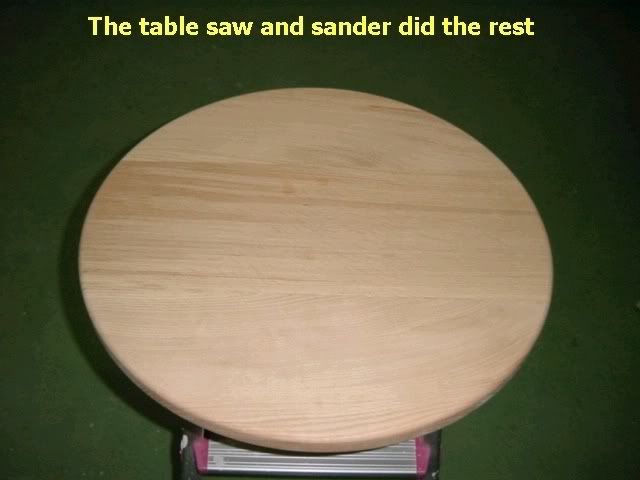
By the way, before, I was cutting occasional circles of 24" dia on the table saw (pic below)

Regards
niki

Photo Sharing and Video Hosting at Photobucket
 
#12 · (Edited by Moderator)
Thank you Nicki
I am no stranger to routers and must admit, at this time, I do not use a lift on my table.
I have several other methods at my disposal that help make woodworking safe efficient and enjoyable.

Cheers Bob


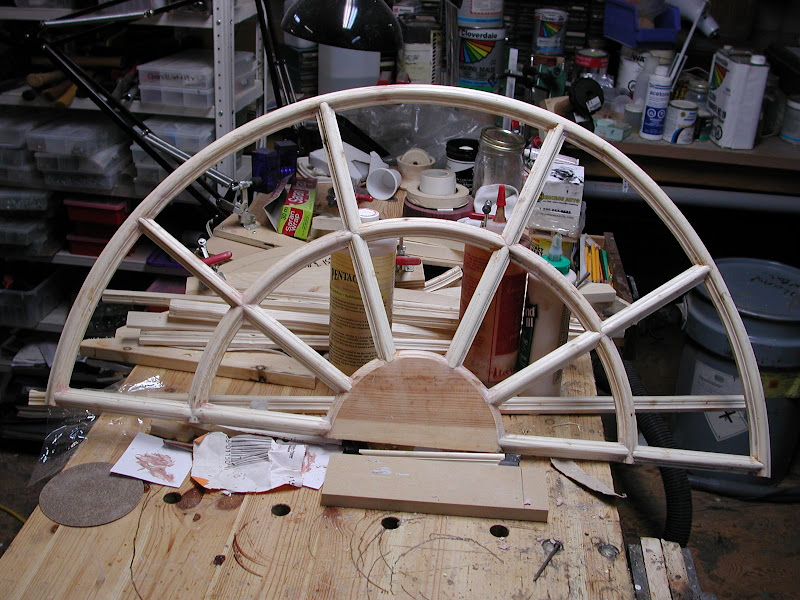
Here's a two piece top tramelled and then shaped with a pattern the rest is just lathe work.

 
#14 · (Edited by Moderator)
Wow Bob
This one is "out of my range"....beautiful

Well, of course everybody has a little bit different methods because we are not "Windows XP" that will work the same way all over the world…

Even in a small group of people you can see the differences because everybody has a little bit different opinion, abilities, capabilities and skills and I think that everybody is correct in his way….

Do you remember the Grrriper post. I would not touch it but, many others (I think that everybody except me) where singing "Hallelujah" to this "Safety device" (not legal in EU)...on the other hand, I will not work on the Table saw without riving knife and guard while many people even does not remember where they put it (still packed it the plastic bag)...everybody is correct with his way…as long as no accidents…

Tom (mot)
So correct….

Best regards
niki
 
#15 ·
Nicki: Just for the record , I wonder if you could point me to the European regulation that bans the Grr-ripper.

I see it advertised over there so now I am a bit confused with your information below:

Do you remember the Grrriper post. I would not touch it but, many others (I think that everybody except me) where singing "Hallelujah" to this "Safety device" (not legal in EU)

http://www.capellemanmachines.be/grr_ripper_veiligheids_duwstuk.htm

Cheers

Bob
 
#16 · (Edited by Moderator)
Hi Bob

Oh yes, they sell it also in UK…it's a free country (or countries) and you can buy everything here (btw, in UK they advertise it as a "router table push block" but, everybody knows the real purpose)

Of course you cannot control amateurs (like in USA) but for registered business the regulation states "Blade guard MUST be installed for ANY operation on the table saw" (as I remember the same OSHA regulation applies in USA) and if an inspector will come and find that somebody is operating the table saw without a guard…or in case of an accident, the guard was not installed…this guy will be in deep….trouble.

Please have a look at this site (it's a 260kb PDF file) and you will see a few interesting things about the EU safety regulations that because of them also the amateurs are getting better and safer machines.
http://www.hse.gov.uk/pubns/wis16.pdf

Regards
niki
 
#18 · (Edited by Moderator)
Hey Nicki:

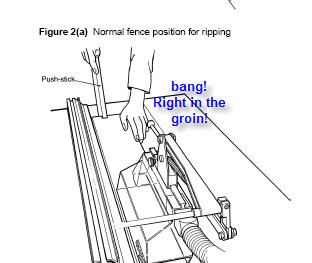
The picture you directed me to shows the operators body position right behind the part being cut.
BTW that push stick shown is actually set to push the work away from the fence. - How clever!

I did not think that the UK rules would apply to the EU?
You're not in the UK are you?

I still can't see where they (the EU) "banned" the Grr-ripper.

BTW, aren't most cabinet shops moving out or the EU due to high wages and costly unworkable regulations?

Can you show me where that regulation is?

Regards

Bob


#19 ·
I think the issue is that the Grrripper only works with the table saw when the blade guard is off the table saw. This makes it incompatable with OSHA requirements, and I think Niki is saying it also violates the EU's (and probably the UK's) labor safety requirements.
 
#20 ·
Peter. I was and am still asking to show me where the device is specifically banned.

That has been the context of more than a couple of messages and I have not been able to isolate the remark.

For some unknown reason, it has again, surfaced here- from an enirely different thread.

It is quite possible that your observations are correct.

I just wanted to stay with the facts.

I have no vested interest in the Grr-ripper.
I own one , I have analysed it's beneifits to me.

Apart from that I just want to see that the truth is presented rather than an emotional opinion.

Best Regards

Bob
 
#22 ·
Peter, only one of the many uses of the GRRipper involve having the guard off the saw…that is only when ripping very thin stock. For many applications using the tablesaw, the GRRipper is just an expensive and complicated push block. However, I own one and also, with no vested interest, have evaluated it's value to me. I'm wondering about Bob's concerns as well.
 
#23 ·
Hi Bob

The EU safety regulations are one and they are the same for all the EU countries including UK and Belgium (the site that you pointed is from Belgium). They are translated to 22 languages of the EU countries.

The Gripper is not "banned" in EU because it's not dangerous as a tool…it cannot cause any injury by itself… unless, you through it on somebody :) the "ban" is on using any device that requires the removal of the guard on any machine.

Please go to this site and you will see many Q&A of the EU safety comity - Brussels - Belgium (as you can see on page 3)
http://ec.europa.eu/enterprise/mechan_equipment/machinery/facts.pdf
Go to page 113 and you will see that a guard must be installed on all the machines that are "manually loaded" and "manually unloaded".

Also, please have a look on pages 115 , 116

It was just convenient for me to give you the UK safety regulations (the most easy to find) but they are the same regulations as in all the EU (that is very difficult to find).

About the picture…it's just a drawing but, we are not afraid to stand behind the part because we have Riving Knife and "Short fence" (by law) for ripping and that combination is satisfactory to prevent kickback….the new table saws in USA are equipped with riving knife but still operated with "long fence" that can cause a kickback and maybe that's the reason that American table saws are equipped also with "anti kickback pawls" that are not required in EU.

About the Griper, if you are visiting WoodNet you could read a few days ago that the handle just broke during operation and the guy had some thoughts about using it…very long post with many "anti" using the Gripper…

By the way, here is what the US OSHA is saing about the guard
http://www.osha.gov/pls/oshaweb/owadisp.show_document?p_table=STANDARDS&p_id=9837
1910.213©(1)
Each circular hand-fed ripsaw shall be guarded by a hood which shall completely enclose that portion of the saw above the table and that portion of the saw above the material being cut. The hood and mounting shall be arranged so that the hood will automatically adjust itself to the thickness of and remain in contact with the material being cut but it shall not offer any considerable resistance to insertion of material to saw or to passage of the material being sawed.

So, there is no "ban" on the Gripper but if you'll use it, you are not obeying even the US OSHA safety regulation.

Regards
niki
 
#24 ·
Niki, did that gentleman on Woodnet ever identify how he broke the handle on the Grripper? Having looked over the handle and construction of the unit, it escapes me on how one could possible achieve that.
 
#25 · (Edited by Moderator)
Niki:
OSHA is Occupational Health and Safety only in the U.S. and does not apply to individuals .
It regulates commercial operations.

The "regulation" you tossed up for the EU from the UK. contains a disclosure that saying that the information is only a guidline. Apparently you did not take the time to read it before offering it as a defense for your argument.

I don't know why you can't just be satisfied with not using the gripper and or recommending it.
This fabricated defense of your positon regarding this device is wearing a little bit thin.

If you don't wish to use it then don't. That's a free choice.

Saying that the use of this device is "not legal" in the EU is stretching the truth quite a bit too in that the EU has no jurisdiction in the "garage/hobby shops" of Europe just as the OSHA has none in the U.S.
So far no such Govt body even exists in Canada.
CCOHS promotes a safe and healthy working environment by providing information and advice about occupational health and safety

As for breaking the handle on the Gripper, I would like Tom, like to see how that was possible.
I suspect he broke it elsewhere and then used it on the saw.
Nothing is idiot proof.

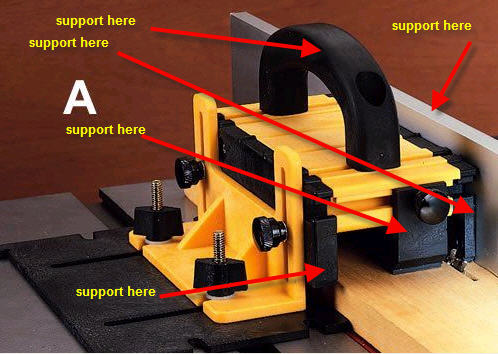
If you look at the pic of the gripper above you will see that it will still function as it should even with the handle missing. You would have to roll over mine with a truck to damage it.
It supports itself in 4 separate places .
The handle is just one of them.

Just to bring this discussion full circle back to the "jig" that you posted originally.
May I point out:
This form of a jig is discussed in the American woodworker WOODWORKING WITH THE ROUTER by Bill Hylton.
Copyright 2006
It is detailed on page 183 of the latest edition along with the comment that it is not the optimal set up for routing circles.
That's all I was trying to point out at the outset.

You were the one that brought up the Gripper again.

Cheers

Bob
 
#26 · (Edited by Moderator)
Bob - OSHA in the US does apply to individuals in certain cases … sort of. Me, for instance. I have been informed by the state that I am subject to OSHA requirements because I have a Federal Tax ID#. I am a sole proprietor with no LLC, no incorporation, and no employees, working out of my own shop on my property, but because I am doing business I am required to follow OSHA guidelines in my shop. I have no idea how that really contributes to the conversation, but I thought I'd throw it in there!